

DIY Blue Jelly OE Breeding Group
DIY Blue Jelly OE Breeding Group
Quantity discount
Quantity discount
The discounts are calculated automatically.
Couldn't load pickup availability
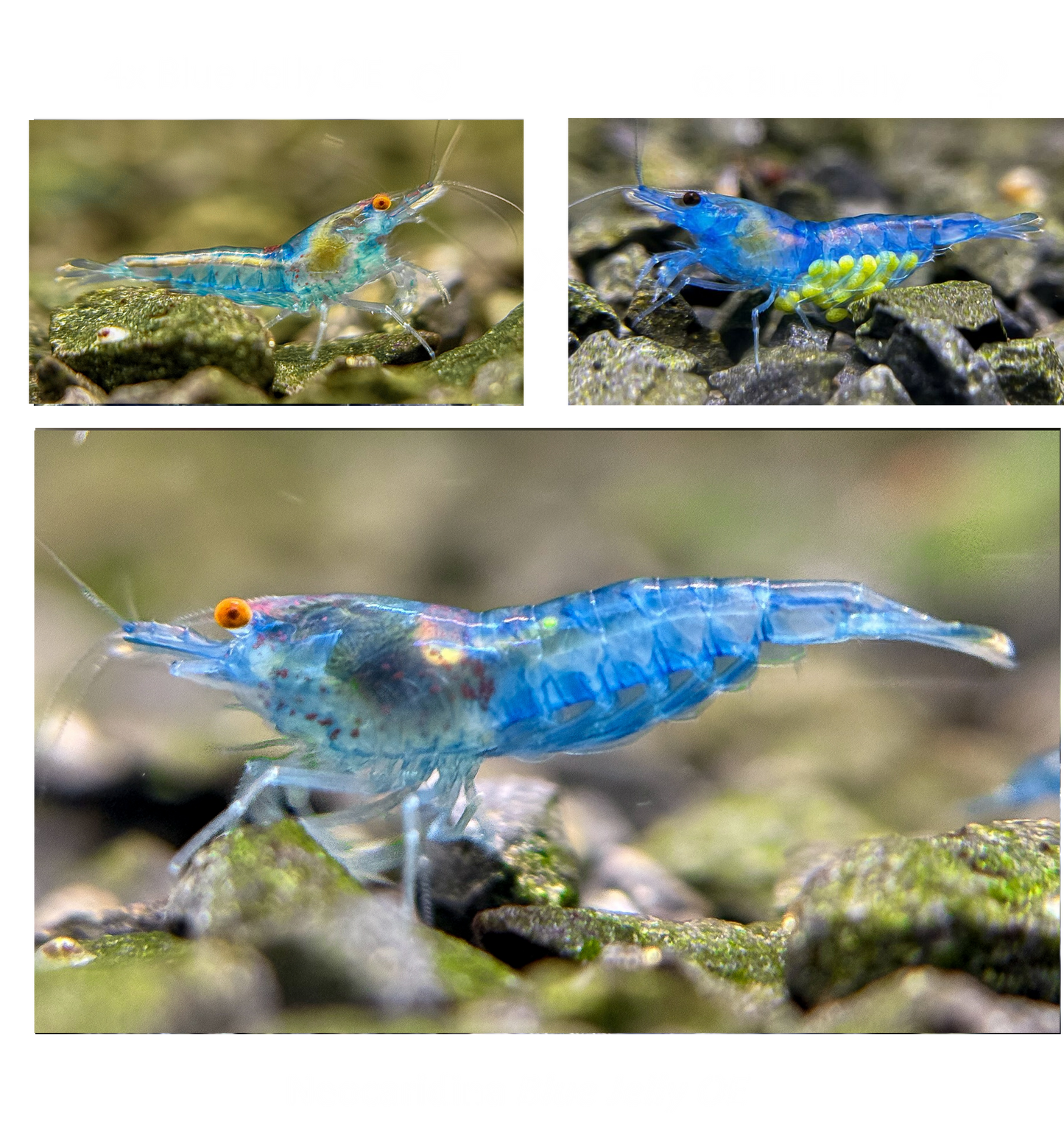
With our Do-it-yourself (DIY) Blue Jelly OE breeding group, you can create your own Blue Jelly shrimp line with orange eyes.
The breeding group consists of:
- 4x Blue Jelly OE males (mid-grade quality; with residual red pigmentation)
- 6x Blue Jelly females
Size at sale: When selecting the shrimp, we ensure that all animals are already sexually mature. The males are selected to the best of our knowledge, however we cannot completely rule out that one of the shrimp may later turn out to be female. Therefore, we cannot guarantee the sex of the orange-eyed males. Males are approximately 1 cm in size, while females are around 1.5 cm, allowing breeding to start immediately.
The crossing process: Only four simple steps are required. We have described them here.
General information
Neocaridina with orange eyes? For about three years now, we have been offering offspring from our Neocaridina breeding lines with orange eyes (OE). The inheritance of the orange eyes is stable and they can also be crossed into other color varieties. Visually, the orange eyes of Neocaridina can be distinguished from those of Tiger shrimp because they have a dark spot in the center, which may indicate remaining pigment. A detailed report about these animals was published in Caridina Magazine (issue 2/2022). You can find more information about this topic here.
Keeping and breeding: Like all dwarf shrimp of the genus Neocaridina, these animals are very adaptable and can usually be kept without problems in tap water (18–26 °C). In our facility, the tap water parameters are: pH 7.6, gH 10, kH 9, conductivity 600 µS, 22 °C. The shrimp feed on common fish food, algae growth, as well as dead plant and animal material. This makes them excellent scavengers that contribute to the biological balance of the aquarium. Keeping them together with small to medium-sized aquarium fish can work, although sufficient hiding places such as moss and roots are recommended. Under optimal conditions, the shrimp quickly grow into lively colonies.
Share
Video
Introduce other complementary products.
DESCRIBE HOW TO PAIR PRODUCTS TOGETHER
Subscribe to our emails
Be the first to know about new collections and exclusive offers.