


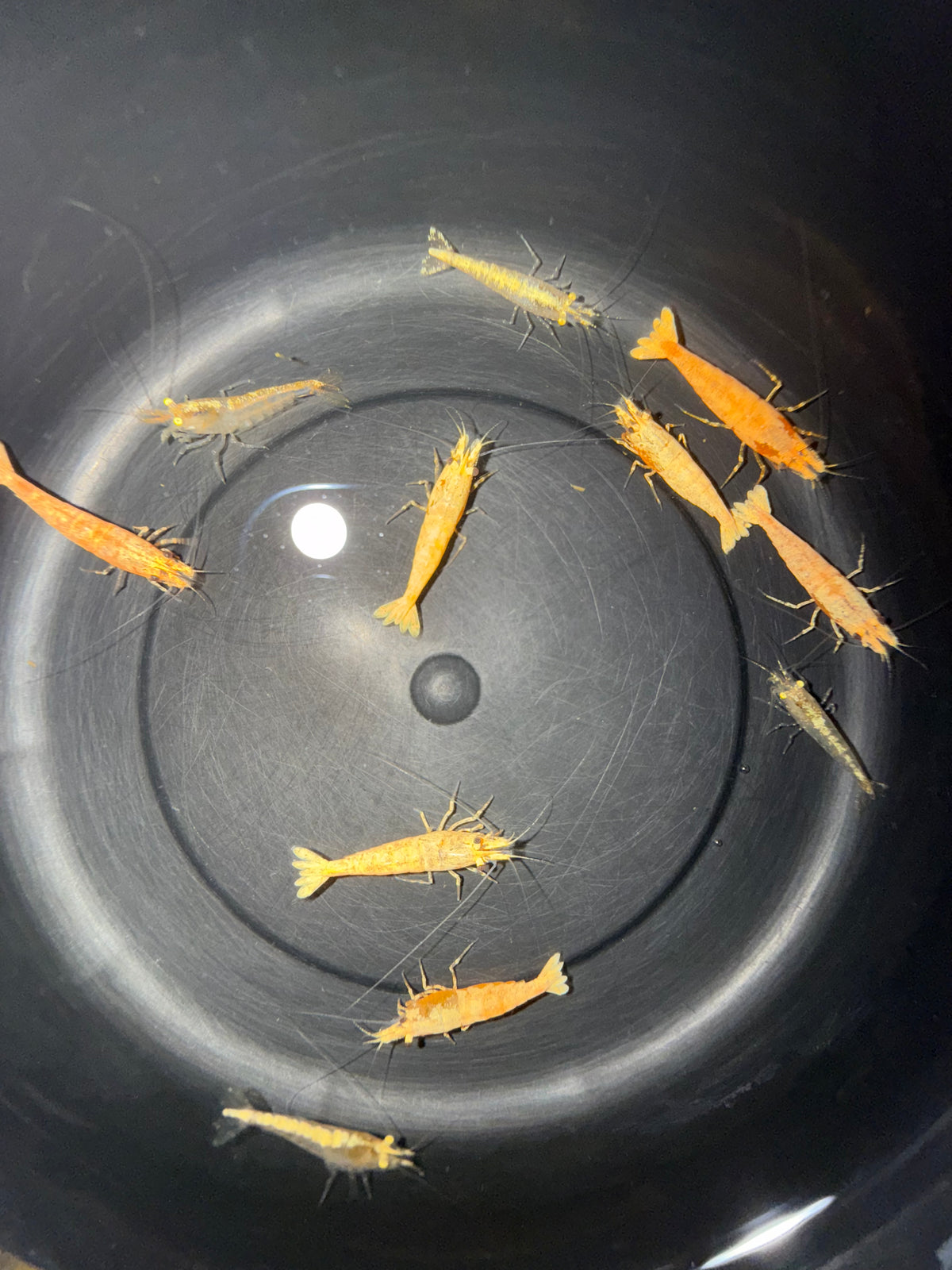
DIY Golden Extreme GE breeding group
DIY Golden Extreme GE breeding group
Quantity discount
Quantity discount
The discounts are calculated automatically.
Couldn't load pickup availability
<p>With our <strong>Do-it-yourself (DIY) Golden Extreme Golden Eye (GE) breeding group</strong>, you can create your own bright yellow Neocaridina strain with a broad backline and yellow eyes. At present, this line does not yet exist in a stable form!</p>
<p><strong>The breeding group consists of:</strong></p>
<ul>
<li>4x Y<a href="https://www.shrimpify.eu/products/neocaridina-yellow-golden-eye" title="Yellow Neon Golden Eye">ellow Neon Golden Eye</a> males (midgrade quality; not perfectly coloured)</li>
<li>6x <a href="https://www.shrimpify.eu/products/neocaridina-yellow-backline-extreme" title="Golden Extreme">Golden Extreme</a> females with an extremely broad backline</li>
</ul>
<p><strong>Size at sale:</strong> When selecting the shrimp, we make sure that all animals are already sexually mature. The males are selected to the best of our knowledge; however, we cannot completely rule out that one of the animals may later turn out to be female. We therefore cannot guarantee the sex of the males with orange eyes. Males are approximately 1 cm in size, while females are around 1.5 cm, meaning that breeding can begin immediately.<br></p>
<p><strong>How to crossbreed them:</strong> Only 4 simple steps are required. We have explained them <a title="DIY Guide" href="https://www.shrimpify.eu/pages/neocaridina-demon-diy-zuchtgruppen"><span style="text-decoration: underline;">here</span></a>.</p>
<p> </p>
<p><strong>General information</strong></p>
<p><strong>Are these the same Neocaridina as the ones with orange eyes?</strong> No! This is an important distinction. While we have been breeding and selling our orange-eyed Neocaridina for several years, the yellow-eye mutation is completely different and originally comes from Asia. However, the inheritance principle is the same, and the combination of yellow eyes and a yellow backline looks absolutely stunning!</p>
<p><strong>Keeping and breeding:</strong> Like all dwarf shrimp of the genus Neocaridina, these animals are highly adaptable and can usually be kept without problems in tap water (18–26 °C). In our facility, the tap water has the following parameters: pH 7.6, GH 10, KH 9, conductivity 600 µS, 22 °C. The shrimp feed on conventional fish food, algae and
Share

Video
Introduce other complementary products.
DESCRIBE HOW TO PAIR PRODUCTS TOGETHER
Subscribe to our emails
Be the first to know about new collections and exclusive offers.